
“It is a game between information and analysis” is a well-known definition used in the field of Business Analytics.
It describes the core challenge of modern decision-making: the struggle to bridge the gap between having raw data (“Information”) and understanding what it means (“Analysis”) to make a smart choice.
Here is the breakdown of the concept, along with a secondary possibility if you are asking about Chess or Game Theory.
1. The Business Analytics Definition
This phrase is widely attributed to the research and advisory firm Gartner and is often taught in introductory Business Analytics courses.
- The “Game”: The constant process of turning raw input into actionable output.
- The Players:
- Information (Data): The “what.” This is the raw material—statistics, historical records, and facts (e.g., sales figures, customer clicks, sensor readings).
- Analysis (Insight): The “so what.” This is the application of logic, math, and models to that information to find patterns, predictions, or solutions.
- The Goal: To achieve “Analytics Excellence”—which leads to better decisions.
Why is it called a “Game”? It implies a strategic interaction. Having too much information without analysis leads to “analysis paralysis” or noise. Having analysis without good information leads to guessing. The “game” is finding the winning balance where the right amount of analysis is applied to the right information to solve a problem. BBA from JIMS VKII campus has in-depth exposure to Business Analytics insights of this Game.
To understand the “game” between them, you must first understand how they oppose and complement each other. While often used interchangeably in casual conversation, in professional contexts (Business, Intelligence, Science), they are distinct stages of value.
Here is the breakdown of Information vs. Analysis.
| Feature | Information | Analysis |
| Core Concept | The “What” | The “So What” & “Now What” |
| Nature | Static | Dynamic |
| Role | The Raw Material | The Processing Factory |
| Orientation | Looks at the Past/Present | Looks at the Future |
| Goal | Awareness | Action/Decision |
| Output | Reports, Dashboards, Facts | Recommendations, Forecasts, Models |
The Golden Rule: Information tells you what happened. Analysis tells you why it happened and what you should do about it. BBA students are well versed with What and Why Analytics every year.
Examples in Action
To see the difference, look at how the same scenario is treated by both:
Scenario A: The Weather
- Information: “There is an 80% chance of rain today and the temperature is 18°C.” (Fact)
- Analysis: “Because it will rain and it is chilly, the outdoor event should be moved to the indoor tent to avoid attendees leaving early.” (Insight + Recommendation)
Scenario B: Business Sales
- Information: “Q3 sales are down 15% compared to last year.” (Metric)
- Analysis: “Sales are down because our main competitor lowered their price. If we don’t offer a discount or improve our marketing value proposition, Q4 will drop by 20%.” (Causal link + Prediction)
Scenario C: National Security
- Information: “Satellite imagery shows 50 trucks moving toward the border.” (Observation)
- Analysis: “Based on the type of trucks and previous patterns, this is likely a supply run, not an offensive buildup. The threat level remains low.” (Assessment)
The DIKW Hierarchy
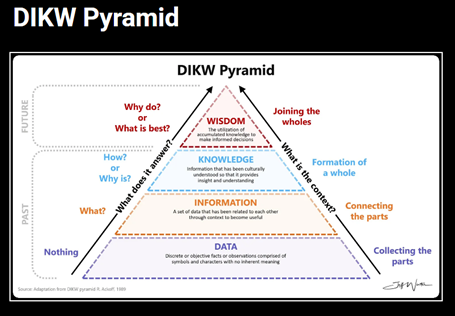
This relationship is often visualized as a pyramid. You cannot have Analysis without Information, but Information is useless without Analysis.
- Data: Raw numbers/symbols (e.g.,
100, 102, 98) - Information: Contextualized data (e.g.,
Heart rate: 100, 102, 98 bpm) - Analysis (Knowledge): Finding patterns/meaning (e.g., Heart rate is elevated compared to resting norm.)
- Wisdom (Action): The decision made (e.g.,
Patient needs medication.)
Why it is a “Game”
The conflict (or “game”) arises because these two forces compete for resources:
- The Information Trap: Organizations often spend 90% of their time collecting information (cleaning data, making reports) and only 10% analyzing it. This leads to “Data Rich, Insight Poor.”
- The Analysis Trap: “Analysis Paralysis.” Over-analyzing allows the opportunity window to close. Sometimes, imperfect information with quick analysis wins the game.
2. The Chess Interpretation (Alternative Context)
If you are asking this in the context of Chess, “Information vs. Analysis” refers to the two main ways a player finds the best move:
- Information (Knowledge/Memory): Relying on what is already known—opening theory, databases, and memorized patterns (e.g., “I know the book move here is Knight to f3”). This is often associated with the Chess Informant (Šahovski informator) style of learning.
- Analysis (Calculation): Relying on what you can work out over the board right now—calculating variations deep into the future (e.g., “If I go here, he goes there…”).
- The “Game” between them: A modern grandmaster must play this game constantly. You cannot rely solely on Information (because you will eventually run out of memorized moves) nor solely on Analysis (because the clock will run out). You must switch between them efficiently.
3. The Game Theory Concept
In the mathematical study of Game Theory, the terms are slightly different but related:
- Games of Perfect Information: Games where everyone knows everything that has happened so far (e.g., Chess, Go).
- Games of Imperfect Information: Games where some information is hidden (e.g., Poker, where you don’t see opponent cards).
- The Analysis: The mathematical attempt to solve these games (e.g., Nash Equilibrium).
BBA course at Jagannath Institute of Management Sciences, New Delhi, with unique pedagogy is nurturing students in the concept game theory to be professionally equipped perfect vs imperfect information.
Dr. Nilima Thakur
Asst. Professor
(BBA Department, JIMSVK-II)