
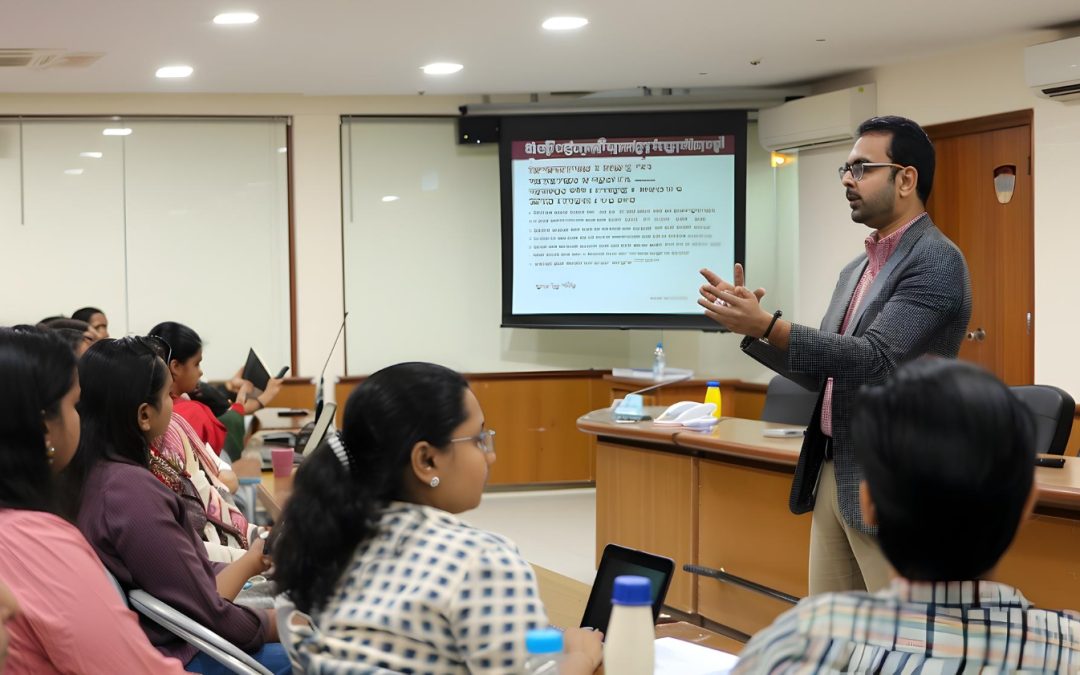
Dr. Nilima Thakur Assistant Professor JIMS VKII
Transforming a classroom into an “effective” learning environment means shifting the student from a passive consumer of information to an active producer of knowledge. When interactivity is baked into the daily routine, information sticks, engagement skyrockets, and teaching becomes vastly more rewarding. JIMS VKII is very keenly taking step towards modern teaching methods of students centric learning.
Here is a blueprint for designing highly effective, interactive classrooms, bridging foundational pedagogy with modern tools.
The Pillars of Classroom Effectiveness
To make interactivity actually drive learning (rather than just being an entertaining distraction), it must rest on three pillars:
- Active Recall: Forcing the brain to retrieve information rather than just rereading it.
- Immediate Feedback Loops: Catching and correcting misconceptions during the learning process, not three weeks later on an exam.
- Social Construction: Allowing students to debate, explain, present and unpack concepts with their peers.
High-Impact Strategies for the Modern Classroom
1. The Dynamic “Pulse Check”
Instead of asking, “Does anyone have any questions?” (which usually results in blank stares), use targeted, real-time polling to gauge comprehension instantly.
- Low-Tech: Whiteboard paddles or colored cards (Red/Yellow/Green) for anonymous, instant feedback.
- High-Tech: Tools like Mentimeter or Kahoot to inject friendly competition and gather data on exactly which concepts need to be re-taught before moving on (reflective assessment).
2. The Tech-Augmented “Think-Pair-Share”
Take the classic collaborative strategy and supercharge it using modern digital sandboxes.
- The Workflow: Pose a complex, open-ended question. Students Think (write down thoughts individually), Pair (turn to a neighbor or join a digital breakout room), and Share (contribute to a shared digital canvas like Padlet or Miro).
- The Value: This ensures introverted students have a voice and creates a living visual map of the classroom’s collective brainpower.
3. Case-Method & Live Simulations
Instead of lecturing on theories, throw students into the deep end of a real-world scenario.
- How it works: Present a crisis Placement Scenario (e.g., a supply chain collapse for a business class, or an environmental disaster for a science class). Placement Scenario
- The Interactive Element: Assign students roles (CEO, PR Head, Lead Scientist). Introduce AI tools during the session to act as a “Live Data Feed,” throwing unexpected variables into the simulation every 15 minutes to force adaptive decision-making.
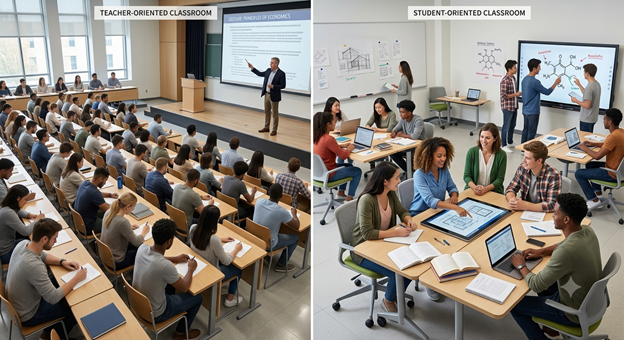
Traditional vs. Effective Interactive Classrooms
| Feature | The Traditional Classroom (Teacher Oriented) | The Interactive Classroom (Student Oriented) |
| Student Role | Passive listener and note-taker. | Active problem-solver and collaborator. |
| Teacher Role | “Sage on the stage” (Information delivery). | “Guide on the side” (Facilitator of experience). |
| Feedback | Delayed (Weeks later via tests/essays). | Dynamic (Real-time adjustments during class). |
| Retention Rate | Low (Information is often forgotten post-exam). | High (Deep conceptual understanding). |
The 10-Minute Rule: Human attention spans naturally flag after about 10 to 15 minutes of continuous lecturing. Effective instructors use this as a hard boundary: lecture for 10 minutes, then trigger an interactive prompt, a peer discussion, or a quick quiz to reset the cognitive clock (formative assessment).
The Ultimate Goal: Cognitive Friction
The most effective interactive classrooms introduce healthy cognitive friction. Learning shouldn’t always feel easy; it should feel like a puzzle. In BBA @ JIMSVasnatkunjII we engage students in CASE study analysis, Simulation games, Role play activities to have real time experience. By setting up environments where students have to argue their points, defend their logic, and use tools (AI or otherwise) to validate their ideas, you turn the classroom from a room full of desks into an intellectual business incubator.
Dr. Nilima Thakur
Assistant Professor
Department of Management Studies